It's Spring Break season here in the Manna house! During March, we have groups from different universities come visit for a week and help us out with programs, see what we do, and get to travel a little bit of Nicaragua. Last week was our first week of Spring Break groups, and we had two at the same time! Maggie and Davis led a group from Vanderbilt who stayed at the Manna house and focused on our Math and Literacy program, and Sam and I were in charge of a group from UNC, who stayed at some nearby dorms and focused on our nutrition and health programs.
It's hard to know what to expect when you're in charge of a group of 11 college students who come on a service trip during their spring break. For some of our group, it was their first trip out of the country. After the week, however, I can say with certainty that this group of college students far exceeded my expectations and I was very sad to see them go yesterday.
We spent most of the week just helping out with the programs and classes that Manna has. On Monday, the group sat in on Sam and my beginner's English class. It was their first full day in the country, many of them spoke no Spanish, and yet they eagerly jumped in to talk with our students and participate in a very competitive game of Jeopardy. Their eagerness to engage with the students and to help out was amazing and added a huge amount of energy to our class. Their positive energy continued throughout the whole week, in everything they did - helping with Milk Day in La Chureca, coming up with exercise routines to help teach women's exercise, working with students in English classes, preparing food for a nutrition demo, doing some manual labor at one of the community centers we work at, and more.
More than any of their work, however, what impressed me most about this group was their questions. Development work is hard, particularly for me as an engineer, because there are a lot of questions and very few clear answers. Are the programs we are running effective? Do they meet the needs of the community we are trying to serve? What needs are most pressing that we can address? Is the community open to our work and do they want what we're offering? Who am I to come in and assume I know what this community needs? After just a few days of seeing our communities and our programs, the group was able to ask and discuss these questions. When we had a wrap-up discussion during our overnight trip to a nature reserve called Tisey, every single student impressed me with their insights and understanding of the work we do and development work in general.
Although it was rather draining to lead a week-long spring break group, it was also one of my favorite experiences I have had this year. It was refreshing to see our programs through new eyes and to get an outside perspective on what we do. It was energizing to soak up some of the positive attitude and energy which the UNC group had, and it was a ton of fun to just sit around and chat with the group. When Sam and I dropped them off at the airport yesterday, I literally almost cried saying bye to them - we miss them already!
This week, a group of girls from UGA are here and are working with some nearby preschools! We'll host our last group next week, a group from Worcester State University. It'll be a busy month, but definitely an enjoyable one as well!
Monday, March 12, 2012

Tuesday, March 6, 2012
Otra vez, otra vez!

"Otra vez, otra vez!" (again, again!)
That's what I heard every time I tried to stop giving (not-that-small) kids piggy-back rides last Friday. Maggie and I spent about an hour and a half hanging out with one of the families in our child sponsorship program in La Chureca. Esteven is an incredibly energetic 4 year old who often seems to be a monkey as he climbs all over us as if we were jungle gyms. His older brother Jose and cousin Richard are just as energetic. I had never met Richard until Friday, but about three minutes after getting to Chureca, he was on my back and I was running back and forth giving him a piggy-back ride. And there-in lay the problem: once one starts giving piggy-back rides, one is expected to continue indefinitely. Occasionally, one is also expected to give rides to multiple kids at once. Needless to say, although I took many breaks, I was still pretty exhausted by the time we were ready to leave Chureca. I was also pretty darn dirty, both because of Richard's dirty hands and feet which got all over my t-shirt and because I slipped and fell while punting a random American football that Jose and Esteven had.
One of my favorite things to do here in Nicaragua is just spend time hanging out with families - sitting and talking with the adults, and running around playing with the kids. It is something which I often have a chance to do in Cedro Galan - it's a short walk or bus ride from the house, we're there all the time, and it's safe to walk around. In Chureca, however, it's less common to be able to spend a long amount of time with one family. We're not there as much, it's not a great idea to walk around alone, and we have to visit a lot of families with the time we do have. Spending more intentional time with families in Chureca has been one of my goals since getting back in January. It's hard to do since it's not fully in my control - like I said, I can't just hop over to Chureca and walk in whenever I want, and I have to work within certain timeframes. But the opportunities I have had to sit down and talk with mothers in our program have given me a better understanding of their lives in Chureca, what's going on in their families, and how their kids are doing. It has been a huge blessing to have these opportunities. Having an hour and a half to play with Esteven, Jose, and Richard and talk to their mother, Karla, was an unexpected highlight of last week for me.
And when I'm talking to a friend or running around with some kids, it doesn't even really register that I'm in a trash dump, or that the person I'm talking to lives in a one-room shack made of plastic tarp which a family of five call home. All I realize is that I have been blessed to meet these people and get to know them and learn from them this year - which is far more important and relevant than the garbage trucks driving by and the shack that I'm sitting outside.
Saturday, February 25, 2012
Volcan Mombacho
Nicaragua is known as the land of lakes and volcanoes, and last weekend I had the opportunity to check out one of the volcanoes named Volcan Mombacho. Mombacho is about 1.5 hours from Managua, and very easy to get to. It's a semi-active volcano with a maximum altitude of 1400ish meters.
I headed out Friday morning, and met up with two friends in Granada. From there, we rode a pick-up truck up the volcano to the ecological station. On the way, we passed through the plantation where our coffee is grown! As we gained altitude, the air became cool and crisp - a nice change from the hot and humid air which I'm normally in nowadays. :-) The ecological station is located at 1150 meters, and contains a 10 bed hostel/dorm. My two friends and I were the only overnight guests that night, so we had the whole room to ourselves!
Our guide for the trip, Samir, explained a little bit about the area to us and then explained our hiking options. There were three options: an easy 1 hour walk, a really difficult 4 hour walk, or a 2.5 hour mixture of the two. We went for the mixture, which was a good choice - I'm not sure I could have done the 4 hour one, and even the 2.5 hour "moderate" one had some pretty steep climbs! It was more than worth it, however, for the amazing views. For the first part of the hike, we were walking around one of the four craters of the volcano, and mostly could just see into that crater. As we continued, however, we got to a point where we could see out over a huge portion of Nicaragua. The picture below shows part of the view from my favorite look-out point. On the left, you can see Laguna de Apoyo, a crater lake which is awesome to visit and swim in. The town in the middle-ish of the picture is Granada, and the lake to the right is Lake Nicaragua.

The view was amazing in all directions, and we were lucky to have a clear view! By the time we reached some of the higher points, we were completely in the clouds (which I suppose is an expected feature of being in a cloud forest) and couldn't see anything.
One of the perks to spending the night up at the ecological station is doing a guided night hike to find a particular type of salamander and frog, which are endemic to the area and don't live elsewhere. We were lucky enough to find both pretty quickly. The salamander was pretty darn cute, but hard to photograph. The frog was harder to find, since the green color blended into the leaves we were searching in. His big orange eyes gave him away, however!

Another perk of spending the night was hanging out with the guides who were working that night. Samir and one other guide saw us playing cards and decided to teach us some popular card games here in Nicaragua, which were a lot of fun.
When we woke up in the morning, the clouds were even thicker than the night before - when we opened the door to go outside, clouds came inside...literally. It was pretty damp, but we all enjoyed the nice cool weather for the night! We headed down the volcano and did a canopy tour, which consisted of 11 zip lines and 3 hanging bridges - it was a lot of fun and a good adrenaline rush. :-)
All in all, it was a really enjoyable weekend trip and I'm glad that I was able to see a bit more of Nicaragua in a place off the tourist path! I'm trying to take advantage of all the beautiful places in this country in the next four months before I head home, so hopefully I'll have some more blogs about cool places in the coming months!
Thursday, February 16, 2012
Two-month photo update
First of all, I apologize that this blog hasn't been updated in two months. It has been a very busy few months, and there's no way I can adequately tell you about all of it...so I'm going to a photo from each week-ish to give you the highlights of my last two months, and I'll do better in the future about updating every week or two so that I don't have this problem again! Enjoy the photos and descriptions!

We had three weeks off for Christmas and New Years, which was a much appreciated and needed break. To start the trip off, I traveled to Guatemala for a week with two friends - Jesse, who is one of my housemates here, and Taylor, one of my close friends who is working with Manna in Ecuador this year. It was an amazing trip - we went to some really beautiful places, drank way more coffee than anyone should in five days, and just enjoyed relaxing and chatting and being tourists. The picture above is Taylor and I in front of Lake Atitlan, one of the most beautiful places I've ever been.

After Guatemala, I spent a week in Michigan with my parents for Christmas. It was great to spend time with family and with friends who I hadn't seen in a while - it's always fun to reconnect. It's especially fun to reconnect when there are new babies to meet - the picture is my friend Stephanie's new baby boy, Lucas, who I am so glad I was able to meet and cuddle with while home!

The next location for my break was Houston, and it was fantastic to catch up with community there. I have realized even more since being away from my community in Houston how much of a blessing it is. Being surrounded by people who challenge you to grow while still being incredibly loving and supportive is something I don't take for granted, and I am excited to be back in the same place as my community of friends this summer! The picture above is some of my friends (and youth ministry teens) after Mass - I love and miss them all!

After getting back to Nicaragua, we had a lot of visitors in the house. My boyfriend, John, was able to visit for a week, and it was really great to show him around my communities here and also to travel a little bit. Here we are at the top of a hike near Matagalpa, a town in the north of Nicaragua.

We're back in full swing on programs now! Here are some of my beginner's English students, who are also in our teen English class, hanging out by our car after class. These boys are amazing - I'm looking forward to visiting in a few years and hearing them speak great English!

This is my kid's English class, which actually just ended. I'm a bit sad to see it end, but these kids are great! Enjoy their silliness!

This last week is probably the most fun - a kid in Christin and my English class gave us this post card a couple weeks ago. We're still unclear on what it means...let me know if you have any ideas!
I hope this was at least a decent update on what I've been up to for the past two months - expect more regular updates in the future for sure!
Sunday, December 11, 2011
Beans: from field to plate
Last weekend, I had the opportunity to pick beans with a family from the community. I'll be honest: I knew very little about beans before last weekend, other than that I liked eating them and that I eat them a lot here. One thing I have learned since being here in Nicaragua is that most foods involve much more work than we ever realize, and that a lot of factors go into the food business. For example, when we had crazy flooding in October, many crops died. For this reason, prices are now higher at the market for some staple vegetables.
I was excited to learn some more about beans and how they get from the field to my mouth. Here's a brief overview of the process, along with some pictures:
Step #1: Plant beans. This happens twice a year, and I haven't seen this step yet. Martha, Alejandro, and David have promised me that I can go with them when they plant in May, though...so expect an update on step 1 in May!
Step #2: Let beans grow. Pretty self-explanatory.

Step #3: Hike up to the fields where the beans are, wearing long sleeves and pants. Once you reach the field, you'll realize why you have long sleeves and pants on - in addition to the bean plants, there is a large amount of super prickly stuff intermixed with the beans. Ouch.

Step #4: Step on super prickly stuff, reach down, and pull out bean plant. Beans grow in little pods, which are on a small plant. When you pick it, you just pull the whole plant (including roots) out of the ground. You pick with one hand while you hold all your picked plants in the other hand, until you can't hold them anymore. Then you go put them in a pile to collect later.

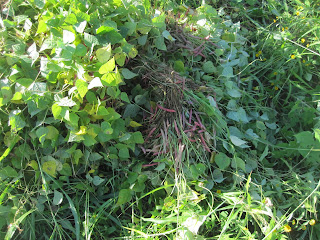
Step #5: Pick the little pods off of the plant, and put them in something to carry them home.
Step #6: Open up the pods to get the beans out. Put the beans in one container, and the pod covers (my bean terminology is not very good. Sorry.) in another one to throw out. This step takes a deceptively long time....
Step #7: Wash and cook your beans!!
Step #8: Eat your beans!
Needless to say, I really do appreciate beans more now - and am still enjoying eating the beans I picked! It took a long time, though - we picked beans for about 1.5 hours, then it took at least 30 min to fill my backpack with beans (with 3 of us working on it), and then it took me a good 4 hours to granar the beans (take them out of the pod). I've enjoyed some beans Nicaragua-style with cheese and tortillas, and also made some pretty delicious chili for more of a taste of home.
The day before I picked beans, I watched a pig get slaughtered....and then ate part of him for lunch. That process, however, is not going to get its own blog entry, since it's kind of disturbing. However, I really do appreciate any opportunity to learn more about life here, and since many families have and slaughter pigs, it was an interesting insight. I was slightly worried it was going to make me become a vegetarian again...but never fear, I'm still eating meat!
This will probably be my last blog entry before winter break, unless I blog from the States - I head off on break on Thursday! Thanks for keeping up with me these past few months on my blog, and I wish each and every one of you a merry Christmas and a blessed New Year!
I was excited to learn some more about beans and how they get from the field to my mouth. Here's a brief overview of the process, along with some pictures:
Step #1: Plant beans. This happens twice a year, and I haven't seen this step yet. Martha, Alejandro, and David have promised me that I can go with them when they plant in May, though...so expect an update on step 1 in May!
Step #2: Let beans grow. Pretty self-explanatory.

Step #3: Hike up to the fields where the beans are, wearing long sleeves and pants. Once you reach the field, you'll realize why you have long sleeves and pants on - in addition to the bean plants, there is a large amount of super prickly stuff intermixed with the beans. Ouch.

Step #4: Step on super prickly stuff, reach down, and pull out bean plant. Beans grow in little pods, which are on a small plant. When you pick it, you just pull the whole plant (including roots) out of the ground. You pick with one hand while you hold all your picked plants in the other hand, until you can't hold them anymore. Then you go put them in a pile to collect later.


Step #5: Pick the little pods off of the plant, and put them in something to carry them home.
Step #6: Open up the pods to get the beans out. Put the beans in one container, and the pod covers (my bean terminology is not very good. Sorry.) in another one to throw out. This step takes a deceptively long time....
Step #7: Wash and cook your beans!!
Step #8: Eat your beans!
Needless to say, I really do appreciate beans more now - and am still enjoying eating the beans I picked! It took a long time, though - we picked beans for about 1.5 hours, then it took at least 30 min to fill my backpack with beans (with 3 of us working on it), and then it took me a good 4 hours to granar the beans (take them out of the pod). I've enjoyed some beans Nicaragua-style with cheese and tortillas, and also made some pretty delicious chili for more of a taste of home.
The day before I picked beans, I watched a pig get slaughtered....and then ate part of him for lunch. That process, however, is not going to get its own blog entry, since it's kind of disturbing. However, I really do appreciate any opportunity to learn more about life here, and since many families have and slaughter pigs, it was an interesting insight. I was slightly worried it was going to make me become a vegetarian again...but never fear, I'm still eating meat!
This will probably be my last blog entry before winter break, unless I blog from the States - I head off on break on Thursday! Thanks for keeping up with me these past few months on my blog, and I wish each and every one of you a merry Christmas and a blessed New Year!
Sunday, November 27, 2011
Thankgiving in Nicaragua
Despite being in a foreign country where people don't really know what Thanksgiving is, we had a great Thanksgiving here at the Manna house! Each person in the house contributed by cooking at least one dish, and our spread was impressive - the only big item missing was sweet potatoes, which sadly don't exist in this country. Our meal included turkey, stuffing, squash risotto, cornbread, green bean casserole, macaroni and cheese, mashed potatoes, beets, apple pie, and chocolate pie. It was all delicious, and I particularly liked that every person made something.
We converted our office table into a dinner table, and it was the first time we've all sat around one table and eaten together. Props to my housemates for some great decorating, both of the table and of ourselves...we had pilgrim and indian costumes. See the picture below to realize how awesome we are. Spending time eating together, playing a game, and watching a movie made for an amazing Thanksgiving. :-)

There are many, many things I am thankful for this year...far more than I could ever list in this blog entry. But, here's a sampling of things, big and small, which I am particularly thankful for this year.
- Communities, both here in Nicaragua and back in the US. In particular: the communities I have the privilege to serve in here, my housemates, and the young adult community at St. Clares back at home.
- My Spanish being good enough to communicate what I want to, most of the time.
- Bug spray. (things I am NOT thankful for: the crazy number of mosquitos)
- The fact that the weather is a bit cooler nowadays, at least in the evenings, and that it's not raining all the time.
- Hugs.
- All the freedoms and opportunities that I've been given in my life in the US: education, a well-paying job, a fair political system, safety, etc.
- Friends who constantly challenge me to grow, support me, and hold me to a higher standard.
- Public transportation that allows me to explore this beautiful country.
- Open doors and welcoming smiles.

Sunday, November 20, 2011
The hard questions
If asked to summarize what I've learned in my first 4.5 months in Nicaragua, I think I'd say this: there are a lot of questions and very few clear answers.
That answer, or lack thereof, is contrary to everything that my natural personality would want to say. Let's face it: I was raised by two mathematicians, and have a degree in engineering...I have been taught that questions have concrete answers, and that there is a way to solve any problem given to me. I mention this to explain that I have struggled a lot to admit that simple sentence - "there are a lot of questions and very few clear answers" - and wish more than anything that I could have more answers. Not necessarily less questions, but definitely more answers.
Four years ago, I visited Nicaragua for the first time, as part of a group through the Catholic Student Center at my university. We spent two weeks working in a small remote village called Dos Quebradas. Dos Quebradas has 75ish residents, no electricity or running water, and a one-room schoolhouse. They make a living selling firewood and farming beans and corn on the hills around the village. I struggled a lot during that trip to understand what we could provide to Dos Quebradas that they would really want or need. Was an American understanding of basic necessities the same as theirs? Was the school we were repairing really the best thing we could give them? Is there anything wrong with the poverty they live in if they're happy and mostly-healthy? What does development look like for Dos Quebradas?
I have been faced with similar questions in my work in La Chureca and Cedro Galan. What is the lasting effect of our child sponsorship program? Is there a way we could help Chureca more? How can a mother in our program afford to buy enough alcohol and cigarettes to be drunk and smoking when we see her, but not to feed her family? Do the residents of La Chureca really want to move out of Chureca, like the Spanish government is trying to help them do? How can the moms and kids living in a trash dump still be smiling most of the time? Are we having any long-term impact?
Are English classes really what will help the residents of Cedro Galan and Chiquilistagua? Is me being here for a year really helpful to the people I work with and get to know? How can I possibly transition from this lifestyle back to my eight-to-five job at NASA without feeling like I'm being untrue to myself or the people I'm serving this year? Is my lifestyle here in solidarity with the community members, or am I living too extravagantly? What does success mean here?
I have always connected with music, and the album of the past year of my life has been Beauty Will Rise by Steven Curtis Chapman. He wrote this album after the unexpected and tragic death of his young daughter, and the songs show both his struggles and his faith, woven intricately together. One song is called Questions, and the lyrics include a lot of the hard questions that he had for God at that time. The chorus goes like this: And if you know my heart / The way that I believe you do / You know that I believe in You / Still I have these questions. It brings me comfort to remember that questions and faith are not opposite - I can have all the questions above, and so many more, and yet not doubt that there are answers, even if they haven't been revealed to me.
On Friday, I had the chance to go back to Dos Quebradas, for the first time in almost 4 years. Very little has changed. My favorite kid is in the same grade he was in four years ago and still not wearing shoes, and yet his smile still has the ability to truly light up the world. People still live in their mud houses, jump in the back of the truck to get a ride to town to sell firewood, and get excited when presented with a jump rope or a frisbee. One can ask if our work there really did anything helpful...but then little Henry, who was 5 when we were there and 9 now, asks if we can play duck duck goose like we did last time I was there. And in that moment, the questions don't really matter anymore, and I realize there's more to life than finding answers to all those questions. Maybe what really matters more than any of those answers is a quick game of duck duck goose.
 Dos Quebradas, January 2008
Subscribe to:
Posts (Atom)